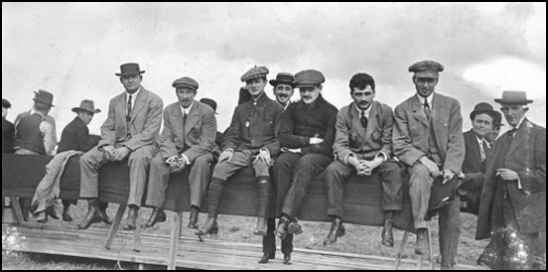
AVIATION MEETS
1910
 
 
Roland Garros
 
 
Garros and his Dog
Library of Congress Collection 7-12-07


WILLARD MAKES RECORD
WITH CURTISS BIPLANE


Noted Aviator Carries Three Passenger
Over Garden City Course.

WILCOX ALSO MAKES FLIGHT

Harmon Remains in the Air for
Over an Hour, Makes Thirty-
one Laps of the Track

(Special Dispatch to The Morning Telegraph)
 
       GARDEN CITY, L. I., Aug. 14, 1910.
     Aviators who are making good are following each other fast and thick on the local grounds here.
     Charles Willard with a Curtiss biplane today established an American record for passenger carrying. He made a 200 yard jump from the Aeronatutic Society sheds to the grand stand, transporting three persons with him. They were Archie Albine, R. F. Patterson, Harry W. Willard.

     Phillip Wilcox, the Columbia student, who has just returned from Pine Camp, N. Y., made a beautiful flight here this morning. It was the second time he had ever occupied an aviator's seat, having taken the aeroplane out to run across the grass once before it met with the accident with Charley Hamilton.
     Today he started the machine in front of the grand stand at about 5 o'clock in the morning, lifted it to 100-foot altitude and maintaining this height steadly, made a complete circuit. He was enthusiastically applauded by the little group of aviators and mechanicians on the ground. Clifford B. Harmon, Willard, Captain Baldwin, Elmer Burlingame, Edwards and Edick and J. J. Frisbee were all included on today's programme.

     Harmon was in the air over an hour and made thirty-one laps of the course. He received, according to the point system of contest, 53 points in all. Captain Baldwin's record for the day was 20 points. Mr. Burlingame did some grass-cutting with The Imp, the first monoplane seen on the field here.
     J. J. Frisbee, the balloonist, caused a near-sensation here today when he took out his new machine and after running along the ground a short distance, lifted the Rochester, as he has named the plane, into the air. But there was trouble with the control and the Rochester plunged and pitched. Just as it appeared ...............
Collection of Peter Kockenmeister, 5-7-06


"Chattanooga's Aviation Meet Begins Today,"
Daily Journal and Tribune,
Knoxville, Tennessee: November 28, 1910,
Transcribed by Bob Davis - 11-18-03
"Chattanooga, Tenn. Nov. 27. - The first aviation tournament ever held in this city will start tomorrow afternoon and continue for the following two days, with John B. Moisant, Charles K. Hamilton, Roland G. Garros, Rene Simon Rene Barrier, John J. Frisbie, and Joseph M. Seymour entered with ten aeroplanes of five different types, These machines include four different Bleriot monoplanes, a Demoiselle monoplane (the smallest heavier-than-air flying machine in the world) , a Hamiltonian biplane, a Rochester biplane, a Seymour-Curtiss biplane, and two Moisant modifications of the present Bleriot.
     The program for the three days' meet includes speed, altitude, distance, duration and cross-country flying. There will also be a race every day between an aeroplane and an automobile. Garros, in his Demoiselle, will at times appear against a local motorist, and Charles K. Hamilton will every afternoon of the meet race his 110 horsepower Fiat Vanderbilt cup racer, the distance for two of the days to be five miles and the third day to be ten miles."
Bob Davis


""Aviators Leave Chattanooga after giving an Exhibition of only a few Minutes.
Claim that the Peril is too Great for Them,
Field is Dangerous Lying Between Hills that form a Peculiar Current,""
Daily Journal and Tribune,
Knoxville, Tennessee: November 29, 1910,
Transcribed by Bob Davis - 5-21-06
Chattanooga, Tenn., Nov. 28. - Eight thousand people stood in the cold for hours today waiting to see airships attempt to fly and at last - after four o'clock - they were pleased to see a Curtiss bi-plane trundled out on the track at Olympia park. John P. Frisbie, of Ireland, mounted the driver's seat and after getting six or eight feet from the ground, Frisbie made a landing, announcing that he had broken some part of his machine.
      Within fifteen minutes Alfred G. Farros, (Garros), in a Demoiselle, made an ascent. He circled the field twice and descended.
      However, Rene Simon decided to fly. Rolling out his Bleriot monoplane, he was in the air a few minutes, and battling with uncertain currents, he mounted to a height of about 500 feet, and circled the field four times. Simon cut the figure eight and went through a number of daring maneuvers. He passed over historic Orchard Knob and the national cemetery and went north almost to the Tennessee river. Coming nearer the ground, Simon brought his monoplane almost on a level with the top of the grand standand flew close to the crowd. Again he flew far to the south and came down on the field witrhin a few feet of the starting point. He was in the air seven minutes.
      Following the completion of the day's flights, it was announced that the meet in this city would be called off for the reason that the field was too dangerous, lying, as it does, between hills which form a most peculiar current and making the peril to the aviators too great.
      The aviators left tonight for Memphis, where they have a three days' meet during this week."
Bob Davis


BackBack Home