
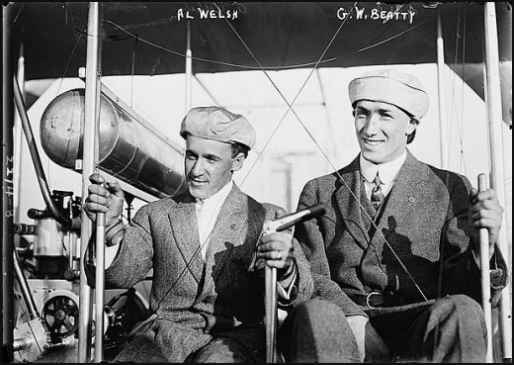
1881-1912 AKA Laibel Wellcher, Leibl Welcher & Al Welsh |
|
|
Library of Congress Archive, 8-3-06 |
 |
|
Library of Congress Archive, 8-3-06 |
 |
|
Library of Congress Archive, 8-3-06 |
 |
|
Courtesy of the Empire State Aerosciences Museum. |
|
Frightful Accident on Army Aviation Field; Wings of Wright Aeroplane Collapse Without Warning. Welch Was Teacher for Wright Brothers, Was Making Test to Meet Government Requirements, With Lieut. Hazelhurst as Passenger Young Army Officer, Third to Be Killed Was Macon, Ga. Man Welch Leaves Family Chattanooga, Tennessee, Daily Times, June 12, 1912, Transcribed by Bob Davis - 8-22-05 Although an army board was immediately appointed to determine the cause of the accident, it is probable the real cause of the machine's failure never will be known. The crash came so suddenly and unexpectedly that the two men met their death without being able to make a single move to arrest their fall. Seven army air men were among the score of spectators, but they can not explain the accident. It was shortly after 6 o'clock that the Wright machine was run out in front of the long line of hangars. For several days Aviator Welch, whose home is in this city, had been busy demonstrating the aeroplane. All of the war department's requirements had been met except a climb of 2,000 feet within ten minutes, carrying a load of 450 pounds. Welch knew the machine was capable of meeting the test, for it had been accomplished at Dayton, Ohio, by Orville Wright before it was taken to College Park, and he had been made; impatient by several failures. "I'm going to make that climb tonight or know the reason why" he said as he began to tune up. "I am tired fooling" he added. A few minutes later he announced that he was ready. Lieut. W. Hazelhurst followed Welch into the machine, taking the passenger's seat. The aeroplane moved off steadily and flew the length of the field, rising 200 feet. As it was turned toward the group of army officers before the hangars, Welch dived sharply to indicate that he was ready for the stiff test climb. The dip carried the machine to within about seventy-five feet of the ground, and it then straightened out sharply, too quickly, the observing army officers thought. Without warning the aluminum wings crumbled or collapsed upward, so that they almost met above the engine. The machine dropped, then turned her nose toward the earth and dived. Bodies of Victims Are Badly Mangled The accident occurred about 1,000 feet from the hangars, and when the first witness reached the wreck it was seen that both of the men were dead. Welch was buried in the debris, but the body of Hazelhurst had been catapulted fully twenty feet away as the machine struck. Welch's clothes were practically torn from his body, which was bruised and battered. Hazelhurst's skull was fractured and his head badly disfigured. Death to both of the men had probably been instantaneous. Their bodies were rushed in army automobiles to Walter Reed hospital, in this city. Five minutes after the flight began the flag over the aviation field was at half mast. Capt. Charles Def Chandler, commanding the army aviation corps, at once convened a board of inquiry, consisting of seven army officers who had witnesses to the catastrophe. A preliminary inquest shed little light upon the cause of the tragedy, as night fall made it necessary to postpone the investigation until tomorrow. The officers who are making the investigation are Capt. F. B. Hennessey, president; Capt. Paul W. Beck, Lieuts. Harry Graham, R. C. Kirtland, and T. Dew Milling. Lieut. William C. Sheeman of the engineer school, Washington, and Lieut. B. D. Foulois, an army aviator, will be among the important witnesses. As the gathering dust (should be dusk) made impossible a careful examination of the wrecked machine, it was kept intact today in the hope that a fuller examination tomorrow might partly reveal the cause of the accident. Many new features were embodied in the machine, evolved as a result of Orville Wright's experiments at Kill Devil Hill, N.C. last summer. The Wright brothers always built comparatively slow aircraft, but the government required that the new machine should make forty-five miles an hour. In speed trials several days ago, 50.8 miles was attained. It was estimated that it was making about forty five miles an hour when the fatal plunge came. The wings of the craft were aluminum instead of canvas, but in appearance it was much like the earlier machines. It (the wingspan) was narrower by one foot, but with a vertical rudder a bit larger. The six cylinder engine was fifty horsepower, instead of thirty. The opinion was expressed tonight that the engine was in no wise responsible for the disaster. Lieut. Hazelhurst was in his twenty-sixth year and was unmarried. The family home is Macon, Ga., but he was appointed to West Point from Mississippi, being graduated and commissioned as second lieutenant in 1908. He had been with the aviation corps since last March when he was detained to it at Augusta, Ga., the winter camp. Mr. Welch, for several years a resident of Washington, had for three years been with the Wright brothers, conducting many of their exhibition flights. He had made a number of public appearances, and after the Wrights abandoned exhibition flights, became one of their instructors. He is survived by his wife and a 8 year-old daughter. Lieut.Hazelhurst is the third army officer to die in an aeroplane plunge. Lieut. Thomas E. Selfridge met death in a machine that fell with him and Orville Wright at Ft. Meyer, Va., in September 1908, and Lieut. G.E.M. Kelly received a fatal fall on an army aviation field at San Antonio, Tex., last year. |
|
Friday Night, December 5, 2003 Welsh became interested in aeronautics after he observed Orville Wright's flights at Ft. Myer, VA, in 1909. In 1910, Orville and Wilbur Wright accepted him into their first flying class, where he worked closely with them, first as a student and, subsequently, as a pilot and instructor at the Wright Flight School in Dayton, OH. Among the people Welsh trained were Henry H. (Hap) Arnold, who later became a five-star general and U.S. Army Air Chief of Staff during WWII. In 1912, the Wrights sent Welsh to the U.S. Army Signal Corps in College Park, MD, to serve as a civilian test pilot for a new plane for the War Department. On June 11, 1912, Welsh, accompanied by Signal Corps Lt. Leighton W. Hazelhurst, was attempting to complete final military tests of the Wright Model C airplane when the airplane buckled under its 450- pound load. Both men were killed instantly, the first-ever fatalities at College Park. The Washington Times, Jewish Forward, and various aviation publications, including Fly and Aero: America's Aviation Weekly, covered Welsh's death. He is buried in the synagogue's Alabama Street cemetery in Southeast Washington. The service will include a discussion of Welsh's life as a Jewish Washingtonian as well as the milieu of early aviation. Several never-before-seen photographs and momentoes of Welsh's work from the JHSGW archives, including a small black and white photograph depicting Welsh preparing for a two-hour test of the Wright military planes on June 3, 1912, will be on display. An Oneg Shabbat reception follows the service. We thank Laura Apelbaum and the Jewish Historical Society for helping us honor and remember an important member of our congregation and community. Published by the ADAS ISRAEL CONGREGATION |
|
|
|
|
|
|
|
|
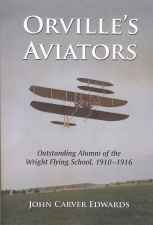 |
ORVILLE'S AVIATORS Outstanding Alumni of the Wright Flying School, 1910-1916 John Carver Edwards Product Details Paperback: 200 pages; 9.9 x 6.9 x 0.7 inches Publisher: McFarland (May 13, 2009) List Price: $45.00 Used Price: $33.33 # ISBN-10: 0786442271 # ISBN-13: 978-0786442270 |
|
Product Description from Amazon.com The six pioneers profiled here were promising graduates of the Wright Brothers' School of Aviation, which flourished in Ohio from 1910 to 1916. These airmen fairly represent their 113 fellow alumni in their all-consuming love of flying. The pilots are Arthur L. Welsh, a Russian immigrant who rose to become Orville Wright's chief instructor; Howard Gill, heir to an international tea dynasty; Archibald Freeman, whose flour-bag bombing of Boston Harbor won him attention as an early exponent of the supremacy of air power; Grover Cleveland Bergdoll, whose promise as a pilot quickly soured; George A. Gray, whose marriage resulted in an extraordinary husband and wife exhibition team; and Howard Max Rinehart, aerial mercenary, international racing competitor, Wright test pilot, South American explorer, and co-owner of one of America's premier charter services. About the Author John Carver Edwards served as university archivist at the University of Georgia before retiring in 2000 as special projects archivist. He has authored dozens of historical articles and scores of book reviews. He is a book reviewer for Library Journal. He lives in Cleveland, Georgia. |
 |
|
Arthur Welsh crashed and died on June 11, 1912, when the Wright Model C aeroplane he was testing
failed. Published by the ADAS ISRAEL CONGREGATION |
|
If you have any information on this pioneer aviator, please contact me. E-mail to Ralph Cooper Back 

|