Reading for Everyone |
|
A CONVERSATION WITH BLERIOT After I did these most interesting experiments which I executed myself and not, like so many others do launching scale models from the top of a table, I went to see Mister Blériot. "Sir, I said to him, I have an idea which I want to suggest to you..." "Tell me!" "But it's an idea which will be a sensation....." "Tell me anyway!" "Here goes: I'm coming to ask you to lend me a standard monoplane to allow me to do the "looping the loop" |
experiments to the cause of aviation showing how safe airplanes are and inspiring confidence to pilots who fear themselves
easely lost. How many got killed for losing their cool-headedness! How many pilots didn't try hard enough, didn't defend themselves
strongly enough to overcome situations that certainly can be regarded as critical, but in no way dangerous, and paid with their life
for lacking the energy to fight back! MY WORK PROGRAM. So happy with my mission I intend to persist: the experiments I conducted until now are just the beginning of a series which will become more and more interesting. Now I'm |
|
with it, to allow me to turn it over, to simulate drops, in one word to try all possibilities of a reversed plane in any direction."
Mister Blériot looked at me attentively. It is clear that he was wondering whether I had become instantaneously lunatic.
I didn't wait for his opinion: "I know what I'm saying: I'm completely lucid," I insisted: "I guarantee success and I'm absolutely convinced that the airplane will show its qualities obeying whatever impulse comes to my mind!" More and more surprised, in the same time baffled by my self-assurance, Mister Blériot asked me some time to consider his answer concerning these sensational experiments and my fantastic propositions. He wasn't in a hurry to give me |
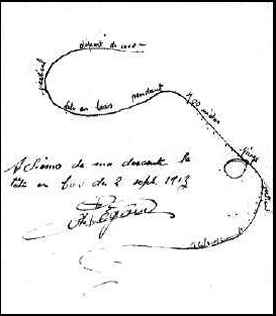
![]() " an autograph of Pégoud - a personally sketched scheme of his upside-down flight at Villacoublay |
planning to overturn the airplane completely crosswise, that is in a vertical angle to the axis of the hull: while turning left or right I'll overturn the plane, not while diving. Subsequently I'll make a drop with the left wing first, then the right wing, followed every time by a horizontal stabilization. I'll drop on the tail and subsequently I'll stabilize horizontally. I'll climb to 1.000 meters; there I'll stop the engine and let the airplane go. I wont touch the controls and I'll see what it will do, being satisfied by picking her up to horizontal flight at hardly 300 meters from the ground. I hope to lead this program to a good ending. If so, I'll crown this series of experiments by "looping the loop", very interesting and rather amusing for cool pilots. |
|
the answer I desired so intensely. Every time I met him at the
"aerodrome" I hassled him with my instigation. Soon, moved by the unshakable confidence he noticed in me and the confidence that I had in the airplane, he allowed me to try my tests with a standard monoplane that he had the kindness to lend to me. My experiments proved that I was right and didn't delude myself. And I'm very happy to have contributed by these |
For, to perform these experiments, it's sufficient to have guts, to stay calm, to have
energy and to be able to withstand large physical strain. As far as I'm concerned, I've nothing to complain about here. To play with the elements in the air in whatever position and in any weather, to let go my airplane as if it were a cork on a restless sea, to put up with the treacherous atmospheric conditions, |
Comments on the Scheme
The text written on the scheme says - most interestingly as the date is mentioned- "scheme of my
upside-down drop of 2 sept. 1913 - Pégoud." I read somewhere that others challenge him being the first . However, the facsimile of
the document looks authentic.Translation by Jan Claes Along the lines of the scheme, from top to bottom, it says: -start at 1.000 m -vertical -upside-down over 700 meters -turn (virage) -vertical -pickup |
|